
Honest Guide to Chimney Cap Installation Massapequa NY: 2026 Guide for Uniondale Residents
A homeowner on Uniondale’s Jerusalem Avenue called us last spring after a raccoon had nested inside her flue over the winter. The liner was cracked, the damper was bent, and the cleanup alone cost more than three chimney inspections would have. The missing cap on her chimney had been there or rather, not there for two seasons. She’d noticed it was gone after a windstorm but figured she’d handle it when things slowed down. They didn’t slow down. That story is more common than most people realize, and it’s why we get into the details of chimney cap installation Massapequa NY calls so often with homeowners from Uniondale all the way down to Massapequa, Bellmore, and Baldwin.
The honest truth is that some parts of this job a capable homeowner can handle. Other parts carry real risks structural, legal, and financial that make a professional the smarter call. We’ll walk through both, clearly.
What a Missing or Failing Cap Actually Does to a Chimney
A chimney cap does three things: it keeps water out of the flue, it blocks animals from entering, and it stops wind-driven debris from landing on the smoke shelf and damper. On Long Island, the coastal climate adds a fourth concern. The freeze-thaw cycles we see from November through March, combined with salt air and elevated humidity, accelerate mortar deterioration faster than in inland areas. Water that enters an uncapped flue doesn’t just sit there it works into the liner joints, expands when it freezes, and widens cracks season after season. According to the CSIA, Long Island’s coastal climate makes annual inspections especially critical for Nassau and Suffolk County homeowners because of exactly this cycle.
A damaged or absent cap also changes how a chimney drafts. When wind hits an open flue at the wrong angle, it creates negative pressure that pushes smoke back into the house. Homeowners in Uniondale and nearby Hempstead frequently describe this as a “smoky living room on windy days” — and often the fix starts with the cap, not the damper.
According to the U.S. Fire Administration, heating fires account for approximately 25% of all residential fires, and failure to clean chimneys is the leading contributing factor. A capped chimney that stays cleaner between sweeps is one practical piece of that safety picture.
What a Homeowner Can Reasonably Handle
We’re not going to tell you that touching a chimney cap is always a job for professionals. That wouldn’t be true, and it wouldn’t be fair to capable homeowners.
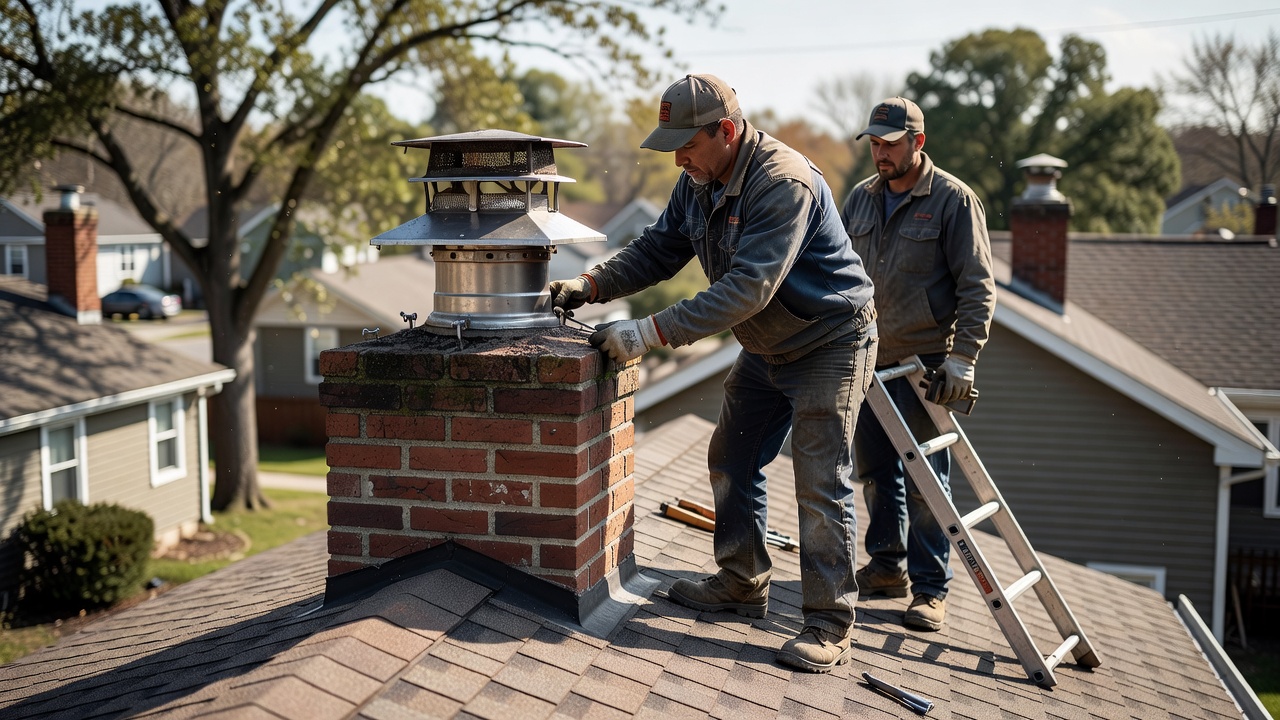
If your existing cap is a standard single-flue galvanized or stainless steel cap the kind that slides over a rectangular clay tile and is secured with set screws and your roof pitch is gentle enough to walk safely, replacing a like-for-like cap is within reach for a reasonably handy person. The measurement is the critical step: you need the outside dimensions of the flue tile, not the inside. Get those right, order a cap that matches (stainless is worth the extra cost), and the installation is essentially a matter of positioning and tightening four screws.
A homeowner can also do preliminary visual checks from the ground using binoculars looking for a missing cap, visible rust, or a cap that’s tilted or has lost its mesh screen. That kind of monitoring between annual inspections is genuinely useful and costs nothing.
Cleaning a removable cap with a wire brush and reassembling it is also reasonable DIY territory, as long as the cap itself is structurally sound.
When You Actually Need a Professional and Why
Here is where we’ll be direct, not because we’re trying to sell services, but because we’ve seen the consequences of the following situations being handled without the right tools or training.
Multiple-flue or custom-built caps. Many older homes in Uniondale, New Hyde Park, and Floral Park have chimneys with two or three flues, sometimes at different heights. A cap that spans multiple openings requires precise fabrication and needs to be anchored to the crown, not just slipped over a tile. An ill-fitting cap on a multi-flue chimney can actually restrict airflow in ways that increase carbon monoxide risk.
Crown damage underneath the cap. The chimney crown is the concrete or mortar slab that seals the top of the chimney around the flue tile. If the crown is cracked or crumbling — which we see constantly in Massapequa, Merrick, and Rockville Centre after hard winters — installing a new cap over a compromised crown is a short-term fix. Water will continue entering through the crown, and you won’t see the damage until it’s inside the masonry. Our chimney inspection service includes crown assessment specifically because of this.
Steep or high rooflines. Falls from roofs are a leading cause of home improvement injuries. If your chimney sits on a steep pitch or extends more than one story above the roofline, the risk of working up there without proper staging or safety equipment is real. This is not about capability — it’s about the physics of a wet asphalt shingle in October.
Code compliance and warranties. The NFPA Standard 211 requires that chimneys be inspected for soundness and correct clearances at least once a year. If you’re installing a new cap as part of a larger repair — say, after a liner replacement or after our team has done chimney repair work — the installation needs to be documented. Some homeowner insurance policies require professional installation records for cap-related claims. A cap you installed yourself on a Saturday morning may void coverage if a water-damage claim follows.
Stainless liner termination caps. If you have a stainless steel liner installed in the last ten years, the cap at the top is part of the liner system and often has specific installation requirements from the manufacturer. Installing the wrong cap or incorrectly seating the existing one can void the liner warranty, which on a quality liner represents a significant investment.
The Real Cost of Getting It Wrong
We price standard chimney cap installation in Nassau County between $150 and $350 for a single-flue stainless cap with labor, which aligns with regional cost data from Angi for 2024-2025. A multi-flue custom cap with crown repair can run $500 to $900 depending on the chimney’s condition. Those numbers sound significant until you compare them to a chimney relining project, which typically ranges from $2,500 to $7,000 or more depending on flue length and liner material the outcome when water infiltration goes uncorrected for two or three winters.
The homeowner in Uniondale we mentioned at the start spent just over $2,200 in total liner repair, wildlife removal, and cleaning. A chimney cap at the time of the windstorm would have cost her around $200.
Talk to Us Before You Decide
If you’re in Uniondale, Massapequa, Westbury, Valley Stream, or anywhere else on Long Island and you’re trying to figure out whether your situation is a DIY cap swap or something that needs eyes on it first, call us. We offer free estimates, and a quick look at your chimney from the roofline will tell us in about ten minutes whether this is a simple fix or something more involved. There’s no pressure either way we’d rather you have the right information than make a rushed decision that costs more later. Reach out to Garden City Chimney Service to schedule a visit.
Frequently Asked Questions About Chimney Cap Installation on Long Island
How do I know what size chimney cap to buy for my home in Massapequa or Uniondale?
Measure the outside dimensions of your clay flue tile the rectangular or round tile that sticks up above the chimney crown. Cap sizing is based on those outer measurements, not the interior opening. Most single-flue caps are sold in standard sizes and will list the flue tile dimensions they fit. If your chimney has multiple flues, or if the crown is damaged, call a professional before ordering anything an ill-fitting cap on a multi-flue chimney can cause draft problems or fail to seat properly against a deteriorated crown.
Does a chimney cap installation require a permit in Nassau County?
A straightforward like-for-like cap replacement on an existing residential chimney typically does not require a building permit in most Nassau County municipalities. However, if the cap installation is part of a larger repair — crown rebuilding, liner work, or structural changes to the chimney — permit requirements can apply. Regulations vary by village and town, so if you’re in Uniondale, Hempstead, or a neighboring community, it’s worth confirming with your local building department or asking your chimney contractor, who should be familiar with local rules.
What kind of chimney cap holds up best to Long Island’s coastal weather?
Stainless steel is the right choice for most Long Island homes. Galvanized caps are cheaper but typically last five to eight years before rust compromises the mesh screen and the cap itself. Stainless steel caps, particularly 304 or 316 grade, resist the salt air and humidity that accelerate corrosion in coastal Nassau and Suffolk County. A copper cap is the longest-lasting option and develops a patina rather than rusting, but it comes at a higher price point. For most homeowners in Massapequa, Merrick, or Bellmore, a quality stainless cap with a lifetime or 20-year warranty is the practical choice.
Related from Garden City Chimney Service: About Contact Home – Everything You Need to Know About Garden City Chi · Reliable and Safe · Finding a Trustworthy CSIA Certified Chimney Sweep Nassau County
Pingback: Smart Chimney Cleaning Garden City NY: 2026 Seasonal Timing Guide for Massapequa Residents – Garden City Chimney Service
Pingback: Honest Chimney Repair Hempstead NY: 2026 Guide for Hempstead Residents – Garden City Chimney Service